

Introduction to Custom Hoodie Sizing Challenges
As a streetwear manufacturing expert and apparel trend designer with years in the trenches of urban fashion, I’ve seen countless independent brands in Europe and the US struggle with sizing their custom hoodies. Whether you’re an indie brand owner launching a DTC ecommerce line, a mature mid-tier label seeking innovative supply chain partners, or a crossover newbie diving into collabs and corporate customizations, getting the custom hoodie size right is crucial. It directly impacts customer satisfaction, return rates, and your bottom line. Poor sizing leads to wasted inventory, higher production costs, and lost loyalty in a market where fit defines the vibe.
In this guide, we’ll dive deep into practical solutions for selecting the perfect size, focusing on real-world problems like accurate body measurements, fabric choices that affect fit, and cost-effective crafting decisions. By the end, you’ll have actionable insights to streamline your production process, ensuring your hoodies fly off the virtual shelves.
Measuring for Precision: The Foundation of Custom Hoodie Fit
Start with the basics: accurate body measurements. For streetwear, where comfort meets style, skipping this step is a rookie mistake. Grab a flexible tape measure and stand naturally. Key areas include chest (around the fullest part under armpits), waist (narrowest point near belly button), hips (widest part), and sleeve length (from shoulder top to wrist bone).
Why precision? A 1-inch error can turn a sleek fitted hoodie into a baggy mess or vice versa. For brands, this means prototyping with your target demographic in mind—think urban millennials who layer under hoodies. If you’re producing for diverse body types, add 2-4 inches to chest measurements for ease, but test samples to avoid overstocking ill-fitting pieces.
Fabric plays a massive role here. Cotton blends shrink up to 5%, so measure pre-wash and factor in. Polyester mixes hold shape better but can feel stiff—ideal for performance streetwear but not cozy loungewear. Cost-wise, opting for pre-shrunk fabrics adds 10-15% to material expenses but saves on returns, which can eat 20% of profits.

SIZE CHART CLASSIC HOODIE | Explore Size Options — NOTHIN’SPECIAL
Decoding Size Charts and Brand-Specific Variations
Once measured, consult size charts—but not just any. Standard charts vary by manufacturer; a Medium in one might be a Large in another. For custom production, always request your supplier’s chart, which lists chest, length, and sleeve in inches or cm.
Compare your measurements: If your chest is 40 inches, aim for a chart listing 42-44 inches for a regular fit, adding ease for movement. For oversized streetwear trends, size up one or two levels, but watch costs—larger sizes use 15-20% more fabric, bumping unit prices by $2-5.
International conversions add complexity for Euro-US brands. Use a conversion table to align US S-M-L with EU 46-50-52. Misalignment here leads to cross-border sizing complaints, inflating logistics costs.
| Parameter | US Standard (Inches) | EU Equivalent (cm) | Cost Impact | Applicable Scenario |
|---|---|---|---|---|
| Chest (S) | 34-36 | 86-91 | Low fabric use, cheaper production | Slim-fit urban wear for lean builds |
| Chest (M) | 38-40 | 96-101 | Moderate, balanced | Standard streetwear, versatile sales |
| Chest (L) | 42-44 | 106-111 | Higher material cost | Oversized trends, broader demographics |
| Sleeve Length | 33-35 | 84-89 | Minimal variance | All fits, focus on arm mobility |
Choosing Fit Styles: From Oversized to Fitted for Streetwear Appeal
Fit style defines your brand’s aesthetic. Oversized hoodies, hot in 2026 street trends, require sizing up for that draped look—great for collabs but fabric-heavy, increasing costs by 20%. Fitted options hug the body, perfect for mid-tier brands emphasizing quality craftsmanship, but demand precise cuts to avoid discomfort.
Craft choice matters: Raglan sleeves offer better mobility for active wear, adding $1-2 per unit but reducing complaints. Dropped shoulders in oversized fits enhance the relaxed vibe without extra cost.
For newbies in crossovers, like enterprise custom hoodies, start with hybrid fits—semi-oversized for inclusivity. Test with samples to control costs; poor fits lead to rework, eating 10-15% of budgets.
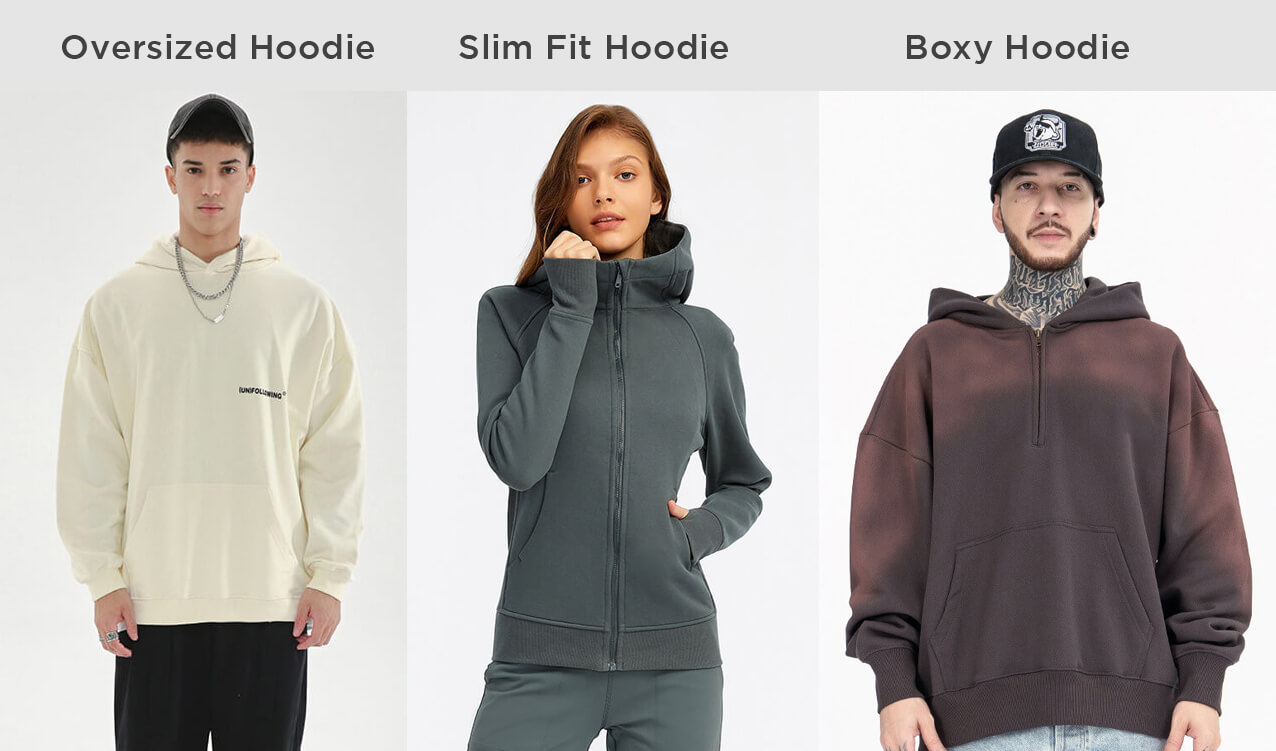
Different Types Of Hoodie- Explanation & Visual Guide – Lezhou Garment
Fabric Selection and Shrinkage Control for Long-Lasting Fit
Fabric isn’t just about feel—it’s sizing’s silent killer. Pure cotton shrinks 3-5% after first wash, so size up or choose pre-shrunk options. Blends like 80/20 cotton-poly reduce shrinkage to 1-2% but may pill faster, affecting durability and perceived value.
Cost control tip: Bulk-buy pre-treated fabrics to cut per-unit costs by 10%. For innovative partners, explore sustainable options like organic cotton, which shrinks less but costs 20% more—worth it for eco-conscious DTC brands.
To prevent post-production issues, wash prototypes in cold water and air dry. This maintains size integrity, avoiding stretching that ruins fits.
| Fabric Type | Shrinkage Rate | Cost per Yard | Applicable Scenario |
|---|---|---|---|
| 100% Cotton | 3-5% | $5-7 | Cozy, budget streetwear; high shrinkage risk |
| Cotton-Poly Blend | 1-2% | $6-8 | Durable mid-tier; balanced cost and stability |
| Organic Cotton | 1-3% | $8-10 | Premium, eco-friendly; for innovative collabs |
| Polyester | <1% | $4-6 | Performance gear; low cost but less breathable |
Use this for decisions: Blends offer best value for stable sizing.
Craft and Production Choices to Optimize Sizing Outcomes
Crafting techniques influence final fit. Flatlock seams reduce bulk for fitted hoodies, adding $0.50 per unit but enhancing comfort. For oversized, use French terry fabric—soft, with minimal shrinkage, but pricier at $7-9/yard.
For full-process outsourcing, like cross-border newbies need, partner with OEM/ODM experts who handle sizing adjustments. This cuts trial-and-error costs by 30%. Learn more about custom apparel production strategies in our related article on Hezi Apparel’s manufacturing insights.

Common Problems in Custom Hoodie Sizing
FAQ: Addressing Frequent Sizing Queries
Q: How do I account for layering in hoodie sizing?
A: Add 2-4 inches to chest for under-layers. Test with tees to ensure mobility without bulk.
Q: What if my measurements fall between sizes?
A: Size up for comfort, especially in cotton; down for fitted poly blends. Always sample.
Q: How does gender affect custom hoodie sizes?
A: Unisex charts work, but women’s fits often need narrower shoulders. Use inclusive sizing for broader appeal.
Q: Can I adjust sizes post-production?
A: Minimal; better to prototype. Returns cost 15-25%—prevent with accurate charts.
Q: What’s the impact of printing on fit?
A: Screen printing adds negligible bulk; puff ink might stiffen, so factor in for tight fits.
Conclusion: Expert Insights from Hezi Apparel’s Production Lens
In wrapping up, nailing custom hoodie size boils down to blending precise measurements with smart fabric and craft choices, all while keeping costs in check. As trends lean toward inclusive, sustainable streetwear in 2026, anticipate a shift to adaptive sizing—AI-driven charts that predict fits based on body scans, reducing waste by 20%.
From Hezi Apparel’s OEM/ODM vantage, the ultimate tip: Collaborate with a seasoned manufacturer who offers full-cycle support, from sizing prototypes to scalable production. This not only solves fit issues but innovates your line. If you’re an indie owner needing stable supply or a collab newbie seeking Hezi Apparel turns your vision into perfectly sized reality—reach out for tailored solutions that elevate your brand.