
In 2026, no single apparel sales model dominates, but the landscape is clear. Traditional offline retail still leads in total volume, while DTC e-commerce and marketplace channels are the fastest-growing and most strategically important for brands. For DTC e-commerce DTG streetwear brands, choosing the right sales model directly impacts margins, inventory risk, design iteration speed, and long-term brand equity.
According to detailed 2026 modeled data for the US apparel market (total ~$583 billion), online channels account for ~39%, with brand-owned DTC e-commerce at 15.5% (the largest single online segment) and marketplace e-commerce at 11.3%. Offline channels still represent ~61%. Globally, offline held an even larger share (~78% in 2025), but online — especially DTC — continues to grow faster. Resale/circular models are expanding 2–3× faster than the primary market and already represent ~9% of global fashion sales.
Info Graph: 2026 US Apparel Sales Channel Breakdown
| Channel Type | Share | Key Characteristic | Relevance to DTG Streetwear Brands |
|---|---|---|---|
| Big box / mass retail | 19.5% | Largest single channel overall | High volume but typically high MOQ |
| Brand-owned e-commerce (DTC) | 15.5% | Fastest-growing online slice | Highest margins + full brand control |
| Off-price retail | 12.0% | Value-focused | Good for clearance but limited brand story |
| Marketplace e-commerce | 11.3% | Strong discovery & reach | Excellent for testing & scaling proven designs |
| Brand-owned retail stores | 10.0% | Experience-driven | Strong complement to DTC |
| Other offline (specialty, dept, etc.) | ~19.5% | Fragmented | — |
Why Choosing the Right Sales Model Matters for DTC E-commerce DTG Streetwear Brands
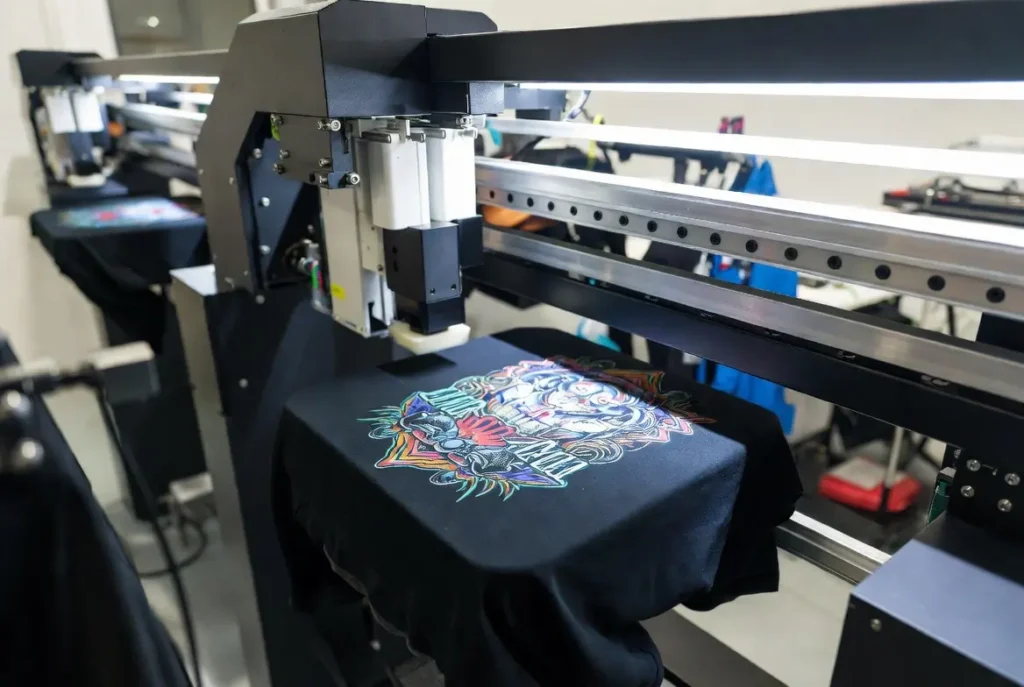
DTC e-commerce DTG streetwear brands thrive on speed, cultural relevance, and the ability to test designs quickly. DTG printing excels here because it requires no screens or setups, supports full-color complex graphics, and enables true low-MOQ or even on-demand production. However, each sales model places very different demands on the production floor:
- DTC rewards extreme flexibility and fast sampling.
- Marketplaces reward consistent quality at scale once a design proves out.
- Omnichannel/hybrid models demand the highest supply-chain agility.
The wrong model can trap brands with excess inventory, slow turnaround, or missed trend windows. The right model lets DTG’s core strength — low-risk, high-flexibility production — shine.

Our 5 Core Evaluation Criteria for 2026 Sales Models
We evaluated models using criteria that matter most to DTC e-commerce DTG streetwear brands from a real production perspective:
- Margin Potential & Cost Structure — DTC typically delivers the highest net margins.
- Alignment with DTG Low-MOQ Production — How well the model leverages DTG’s ability to run small batches and rapid iterations without heavy inventory.
- Brand Data Ownership & Control — Critical for design decisions and customer lifetime value.
- Customer Acquisition Efficiency & Scalability — Marketplaces win on reach; DTC wins on direct relationships.
- Sustainability & Long-term Brand Asset Building — Especially resale integration and omnichannel resilience.
Top 3 Apparel Sales Models for E-commerce DTG Streetwear Brands in 2026
1. Direct-to-Consumer (DTC) E-commerce — Highest Control & Margin
Core Advantage 1: Highest profit potential. Brands typically capture 15–30 percentage points more margin than wholesale or heavy marketplace models by cutting out intermediaries.
Core Advantage 2: Complete brand storytelling and first-party data ownership. Streetwear brands can build community, run limited drops, and collect direct feedback to inform the next collection.
DTG Production Perspective: Excellent match. DTG supports true low-MOQ (often 1–50 pieces per design) and fast sampling (3–7 days typical). This perfectly serves DTC’s “test small, drop fast” culture. Production risk stays minimal because you only print what has already sold or has very high confidence.
MOQ / Volume Fit: Very low. Ideal for testing and limited releases.
Best For: Emerging and growing DTC e-commerce DTG streetwear brands focused on building long-term brand equity and loyal communities.
2. Marketplace E-commerce — Reach & Discovery Powerhouse
Core Advantage 1: Massive built-in traffic and discovery. Platforms provide instant access to millions of potential customers — especially valuable for new or trend-driven designs.
Core Advantage 2: Lower barrier to initial visibility. Many platforms offer advertising tools and, in some cases, fulfillment support.
DTG Production Perspective: Best used after a design has been validated in DTC. DTG remains useful for testing and replenishment, but once volume scales, smart factories shift proven styles to more cost-efficient processes while keeping DTG for ongoing small runs or special editions. Consistency and reliable lead times become critical.
MOQ / Volume Fit: Medium. Works well with print-on-demand partners for testing or factory-supported scaling for winners.
Best For: Growth-stage brands looking to accelerate sales velocity or use marketplaces as a complementary channel to DTC.
3. Omnichannel Hybrid Model (with Resale Integration) — Long-term Resilience
Core Advantage 1: Best risk diversification. Combines DTC’s margin and control, marketplace reach, and optional physical touchpoints or resale programs.
Core Advantage 2: Strong alignment with 2026 consumer behavior and the fastest-growing segment — resale. Younger buyers especially value sustainability and circular options.
DTG Production Perspective: Highest requirement for supply-chain flexibility. The factory must seamlessly handle small DTC orders, larger marketplace replenishment, and resale-related services (reprints, limited re-issues, or upcycling support). Unified order management and rapid response capability are non-negotiable.
MOQ / Volume Fit: Layered and flexible — low-MOQ DTG for DTC + efficient scaling for proven volume.
Best For: More established DTC e-commerce DTG streetwear brands ready to build durable competitive advantage and embrace sustainability.
Info Graph: Top 3 Sales Models Comparison Overview
| Dimension | DTC E-commerce | Marketplace E-commerce | Omnichannel Hybrid |
|---|---|---|---|
| Margin Potential | Highest | Medium-Low | High |
| DTG Low-MOQ Fit | Excellent | Good | Very Good |
| Customer Acquisition | High effort (owned) | Low effort (platform) | Medium |
| Inventory Risk | Lowest | Medium | Low |
| Brand Data Control | Full | Partial | High |
| Sustainability / Resale Fit | Medium | Low | Highest |
| Best Brand Stage | Startup → Growth | Growth | Established |
Channel Selection Guide by Brand Stage & Goal
- Startup DTC e-commerce DTG streetwear brands (focus on margin + brand story): Lead with DTC. Use low-MOQ DTG to test designs aggressively while keeping inventory risk near zero. Add light marketplace testing only after validation.
- Growth-stage brands (focus on velocity + reach): Keep DTC as the core and layer in Marketplace for proven winners. Ensure your production partner can scale quickly without quality drop.
- Established brands (focus on resilience + longevity): Move toward Omnichannel Hybrid, including resale programs. Demand a manufacturing partner capable of true multi-channel agility.
Production-line insight: DTG’s greatest value is de-risking experimentation. Choose sales models that let you leverage this strength rather than forcing high-MOQ commitments before designs are proven.
FAQ — Practical Questions from DTC E-commerce DTG Streetwear Brands
Q: Can DTG really support frequent new design testing under a DTC model?
A: Yes. Professional DTG production routinely handles 1–100 piece runs with fast sampling. This is one of the biggest advantages over traditional screen printing (which often requires 300+ pieces) and makes DTC testing far more economical.
Q: How do margins and production timelines compare when selling DTG products on marketplaces?
A: Net margins are usually lower than pure DTC due to fees and advertising costs. Use DTC first to validate designs, then move winners to marketplaces. Reliable 7–14 day production windows are essential for maintaining seller ratings.
Q: What does a true omnichannel model require from the production side?
A: High flexibility: the ability to run small DTC orders quickly, fulfill larger marketplace replenishment consistently, and support resale reprint or limited-edition programs. A unified order system and an agile manufacturing partner are critical.
Q: Is investing in resale worth it for DTG streetwear brands in 2026?
A: Absolutely. Resale is growing 2–3× faster than the primary market. Brands can participate through limited re-issues, reprint programs, or sustainability storytelling — strengthening brand perception while creating new revenue streams.
Q: How can I reduce inventory and operational risk across multiple channels?
A: Adopt a “produce-to-confirmed-demand” mindset powered by low-MOQ DTG. Avoid building large inventory for unproven channels. Partner with a factory that excels at flexible, multi-channel production rather than rigid high-MOQ runs.
Conclusion: The Winning Formula from the Production Frontline
In 2026, for DTC e-commerce DTG streetwear brands, there is no single “most popular” model. The real winners will be those who treat DTC as the core for direct customer relationships and margin, use Marketplaces as a growth accelerator for discovery and volume, and build toward omnichannel hybrid models (including resale) for long-term resilience and sustainability.
From the production frontline, the decisive factor is not chasing trends but matching your sales strategy to manufacturing reality. DTG’s flexibility only delivers full value when your sales channels allow small-batch testing, rapid iteration, and controlled scaling.
The key to achieving this flexible multi-channel sales strategy with low inventory risk and maximized brand value lies in partnering with a manufacturer who not only masters the technology but truly understands brand value. This is exactly the core strength of professional OEM/ODM factories like heziapparel.com — we deliver advanced DTG printing, true low-MOQ customization, rapid sampling, and multi-channel supply chain solutions purpose-built for e-commerce brands.
Whether you are launching your first DTC drops or scaling an established streetwear line, we help you test faster, control costs, and execute the channel mix that fits your stage.
Visit heziapparel.com to explore our DTC-focused production solutions or contact our team for a tailored discussion on aligning your manufacturing with your 2026 sales strategy.