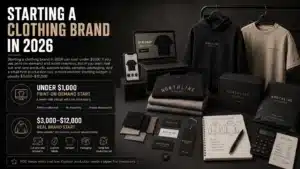
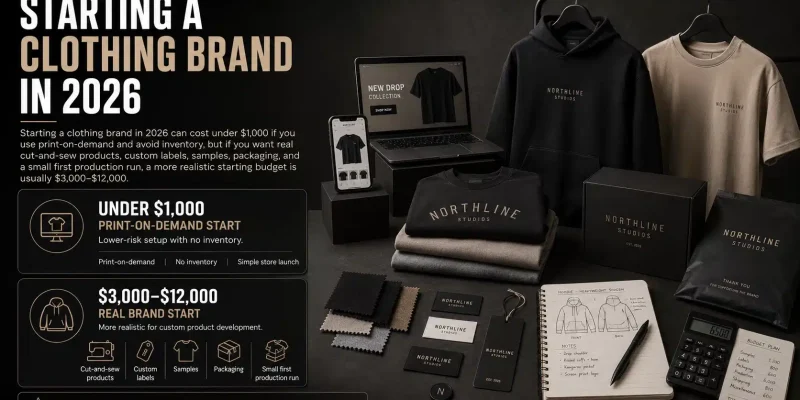
Starting a clothing brand in 2026 can cost under $1,000 if you use print-on-demand and avoid inventory. But if you want real cut-and-sew products, custom labels, samples, packaging, and a small first production run, a more realistic starting budget is usually $3,000-$12,000.
That range is wide because “clothing brand” can mean very different things.
A founder launching one printed T-shirt through a POD platform has a different cost structure from a streetwear brand sampling heavyweight hoodies, custom sweatpants, private label labels, packaging, and low MOQ bulk production. The expensive mistake is using the budget from one model to plan the other.
For a serious apparel startup, the question is not “What is the cheapest way to launch?” It is “How much money do I need to test the product without damaging the brand?”
Quick budget ranges for 2026
Use these ranges as a planning baseline, not a universal quote. Product type, fabric, MOQ, country, decoration, and shipping can move the numbers quickly.
| Launch Model | Approximate Startup Budget | Best For | Main Tradeoff |
|---|---|---|---|
| Print-on-demand test | $300-$1,500 | Testing graphics with no inventory | Low product control and thinner margins |
| Small blank + decoration launch | $1,000-$4,000 | Merch, simple tees, creator drops | Limited fit and fabric uniqueness |
| Low MOQ private label launch | $3,000-$12,000 | New clothing brands testing real products | More planning and sampling needed |
| Cut-and-sew first collection | $8,000-$25,000+ | Original fit, fabric, and construction | Higher development cost and longer timeline |
| Inventory-heavy retail launch | $20,000-$50,000+ | Multi-style collections, wholesale, retail | Higher risk if demand is not proven |
Most new brands should not start with the biggest model. A focused low MOQ launch gives the founder enough control to build a real product while limiting inventory risk.
Brand setup costs: $100-$1,500
The brand setup stage includes the identity work that makes the product recognizable: name, logo, typography, product direction, color palette, basic brand story, and launch positioning.
A founder can do some of this alone, but the cost rarely stays at zero. Even a lean brand may need a logo file, label artwork, hang tag design, packaging stickers, mockups, and a simple style guide.
Typical costs:
- DIY logo and basic assets: $0-$200
- Freelance logo and brand kit: $300-$1,500
- Brand strategy and full identity package: $2,000-$10,000+
- Trademark search or filing support: varies by country and legal route
For a first clothing drop, do not overspend on abstract branding before the product exists. Put enough budget into the brand so labels, tags, packaging, and website feel coherent. Save the bigger brand-system work for after the product direction is proven.
Design and tech pack costs: $100-$1,000 per style
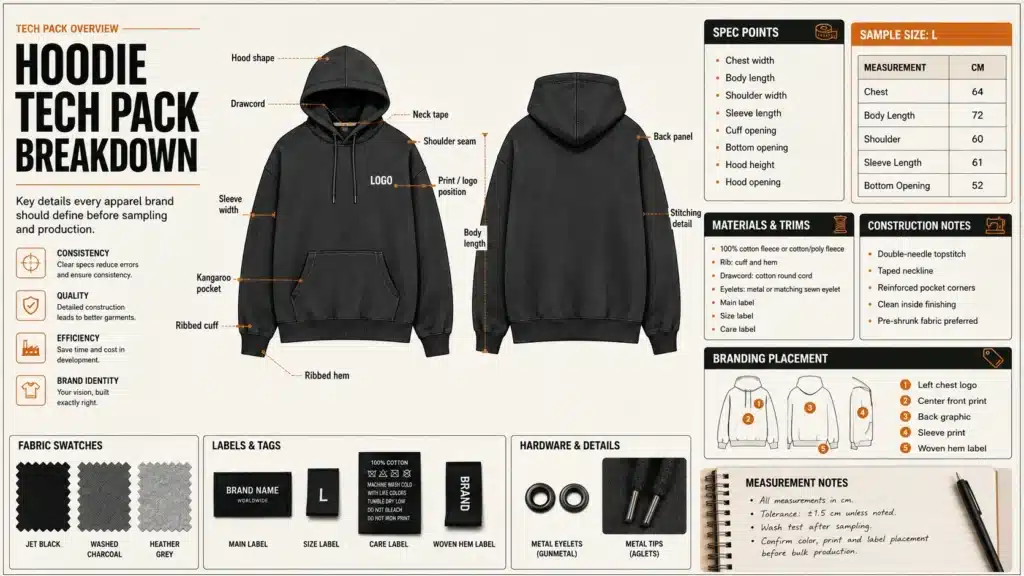
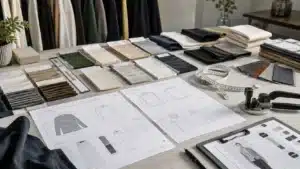
A tech pack turns a design idea into production instructions. It can include measurements, fabric target, construction details, trims, label placement, artwork files, colorways, size grading, and packaging notes.
This is one of the best places to spend money carefully. A weak tech pack creates vague quotes, wrong samples, longer development, and avoidable rework. A clear tech pack lets the factory quote the real garment instead of guessing.
Typical costs:
- Simple production brief: $0-$100 if founder prepares it
- Basic freelance tech pack: $100-$300 per style
- Detailed professional tech pack: $300-$1,000+ per style
- Complex cut-and-sew outerwear or denim pack: higher
You do not always need a perfect corporate-level tech pack for a first conversation. You do need enough detail for the factory to understand product type, fabric, fit, artwork, quantity, labels, packaging, and launch timing.
Sample costs: $50-$300+ per style
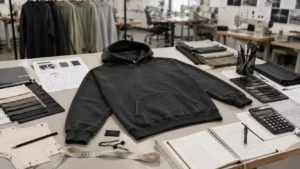
Sampling is where the clothing brand becomes real. The first sample shows whether the fit, fabric, decoration, and construction match the idea.
Sample costs vary because a basic T-shirt sample is not the same as a heavyweight hoodie, acid-wash set, embroidered jacket, or custom cut-and-sew pant. Many low MOQ manufacturers charge for sampling because pattern work, fabric sourcing, printing, sewing, and revisions take real labor.
Typical costs:
- Basic T-shirt sample: $50-$120
- Hoodie or sweatshirt sample: $80-$200
- Cut-and-sew or washed garment sample: $150-$300+
- Multiple revisions: additional cost and time
- Shipping samples internationally: often $30-$100+ depending on location
Do not treat the sample as a display piece. Wear it, wash it, measure it, check shrinkage, inspect stitching, test decoration, and compare it against the size spec. The cheapest sample is often the one that exposes the mistake before bulk production.
First production run: $1,500-$10,000+
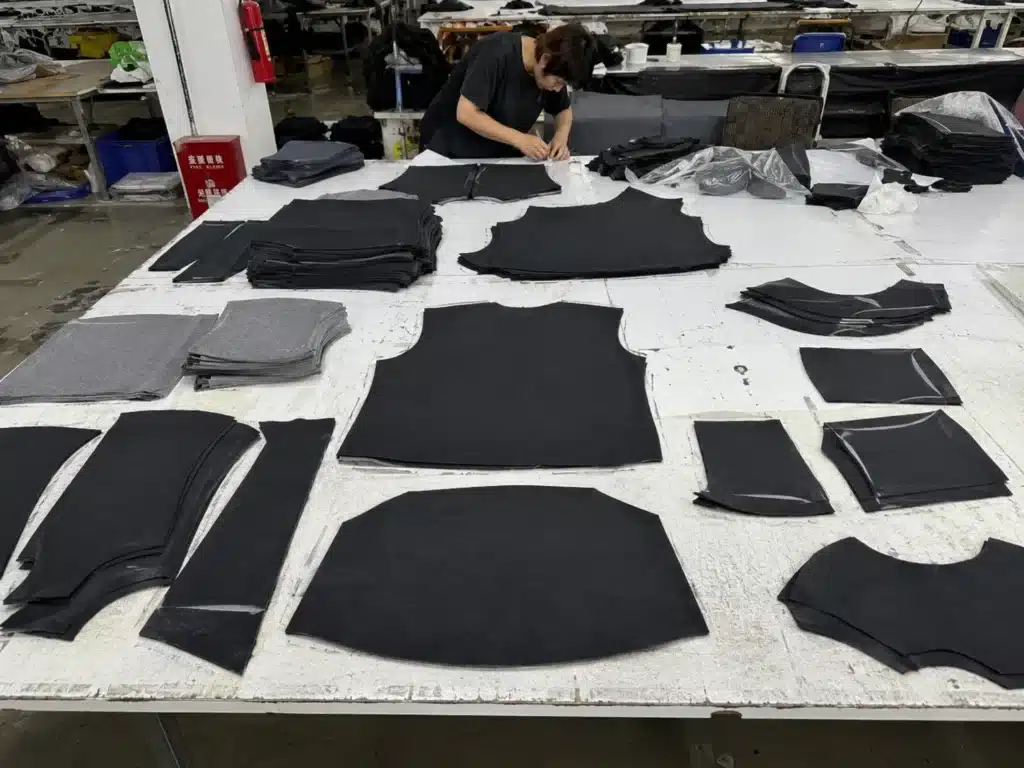
Manufacturing is usually the biggest upfront cost for a real clothing brand. The number depends on MOQ, product type, fabric, decoration, colorways, size range, and whether the factory is using available fabric or developing something custom.
For a low MOQ clothing manufacturing launch, the goal is not to produce the lowest possible unit cost. The goal is to produce enough pieces to test demand without locking too much cash into unsold inventory.
Typical first-run scenarios:
- 50 printed T-shirts at $8-$18 each: $400-$900 before labels, packaging, and freight
- 100 custom tees at $10-$25 each: $1,000-$2,500
- 50 hoodies at $25-$55 each: $1,250-$2,750
- 100 hoodies at $22-$50 each: $2,200-$5,000
- Small multi-style streetwear capsule: $5,000-$12,000+
These are planning ranges, not factory promises. Heavyweight fleece, custom dye, embroidery, puff print, rhinestones, special labels, size complexity, and packaging can raise the total.
Hezi Apparel positions itself around low MOQ streetwear manufacturing, OEM/ODM service, private label support, and startup-friendly production. That kind of supplier is useful when the founder wants a real first batch without jumping straight into large inventory.
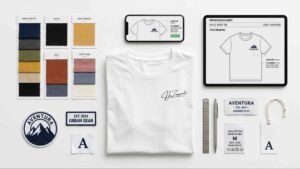
Labels, packaging, and trims: $200-$2,000
Labels and packaging are easy to underestimate. They are small details, but they make a product feel like a brand instead of a blank garment.
Common costs include:
- Woven neck labels
- Size labels
- Care labels
- Hang tags
- Poly bags or paper bags
- Stickers
- Drawcords, zipper pulls, patches, or custom trims
- Barcode or SKU labels
For a first drop, keep packaging clean and functional. A custom box for every order may look premium, but it can eat budget quickly. Better priorities are correct care labels, consistent sizing labels, neat hang tags, and packaging that protects the garment during shipping.
If the product itself still needs fit or fabric improvement, do not spend too much on packaging theater.
Website and ecommerce costs: $300-$2,000+
A clothing brand needs somewhere to sell. The leanest path is usually a Shopify, WooCommerce, Wix, or similar ecommerce setup with a paid theme or simple custom design.
Typical costs:
- Domain: $10-$30 per year
- Ecommerce platform: roughly $30-$100+ per month for many startup setups
- Paid theme: $0-$400
- Apps, email, reviews, size charts, analytics: $20-$200+ per month
- Freelance setup or design help: $300-$2,000+
The common mistake is spending too much on the website before product photos, size charts, and offer clarity are ready. A beautiful site cannot fix weak product positioning.
For a first launch, the site must answer five questions quickly:
- What is the product?
- Why does it cost this much?
- How does it fit?
- When will it ship?
- Why should the customer trust the brand?
Product photography and content: $300-$3,000
Clothing sells through visuals. Customers need to see fit, fabric, color, scale, and styling. For streetwear, they also need to feel the brand world.
Typical costs:
- DIY flat lays and phone content: $0-$300
- Basic product photography: $300-$1,000
- Model shoot: $800-$3,000+
- Video content for launch: $300-$2,000+
- Creative direction, styling, studio, and editing: variable
Do not shoot only lifestyle photos. You also need product clarity: front, back, detail, fit-on-body, fabric close-up, label, and size reference. Returns often start when the customer cannot understand fit before buying.
Marketing launch budget: $500-$5,000+
Marketing is where many founders underbudget. They spend most of the money on production, then launch with no paid reach, weak content, and no customer acquisition plan.
Typical first-launch marketing costs:
- Organic content production: time plus small editing costs
- Paid ads test: $300-$2,000
- Influencer seeding: product cost plus shipping
- Email/SMS tools: $20-$200 per month
- Creator content: $100-$1,000+ per creator depending on scope
- Launch giveaway or sampling: product and freight cost
A new brand does not need a huge ad budget, but it needs a plan. If you produce 100 hoodies and have no audience, the inventory cost becomes a storage problem.
The smarter approach is to start content before the product lands: sample review, design process, fit checks, fabric choices, behind-the-scenes production, and launch waitlist building.
Shipping, duties, and hidden costs: add a 15-30% buffer
The first budget usually misses freight, import duties, transaction fees, returns, damaged pieces, reshoots, extra samples, packaging changes, and emergency rework.
Add a buffer before production starts.
Common hidden costs:
- International sample shipping
- Bulk freight
- Import duties and taxes
- Payment processing fees
- Shopify or app fees
- Returns and exchanges
- Defective pieces
- Extra labels or packaging
- Size-set sample revisions
- Last-minute photo reshoots
For a first bulk order, a 15-30% buffer is not pessimistic. It is normal operating discipline.
Lean launch example: $3,000-$6,000
A lean clothing brand launch might look like this:
| Cost Item | Estimated Budget |
|---|---|
| Brand assets and basic design | $300-$800 |
| Tech pack / production brief | $200-$600 |
| Samples and sample shipping | $300-$800 |
| Low MOQ production | $1,500-$3,000 |
| Labels and packaging | $300-$700 |
| Website setup | $300-$800 |
| Product content | $300-$1,000 |
| Launch marketing | $500-$1,500 |
| Buffer | $500-$1,000 |
This model works best with one or two products, limited colorways, one main decoration method, and a clear audience. It is not enough for a broad cut-and-sew collection, but it can test a brand properly.
Stronger launch example: $8,000-$15,000
A stronger launch gives the founder more room for sampling, better content, and a healthier first production run.
| Cost Item | Estimated Budget |
|---|---|
| Brand identity and direction | $800-$2,000 |
| Tech packs for 2-4 styles | $600-$2,000 |
| Samples and revisions | $800-$2,000 |
| Low MOQ bulk production | $4,000-$8,000 |
| Labels, packaging, trims | $700-$2,000 |
| Website and launch setup | $800-$2,500 |
| Photography and video | $1,000-$3,000 |
| Marketing test budget | $1,000-$3,000 |
| Buffer | $1,000-$3,000 |
This is a better range for a brand that wants custom T-shirts, hoodies, sweatpants, or a small streetwear capsule with real private label details.
How to reduce startup cost without making cheap products
Do not reduce cost by choosing the weakest fabric, skipping samples, or hiding bad fit behind marketing. Reduce cost by cutting complexity.
Better ways to lower the first budget:
- Launch fewer styles.
- Use one fabric family across multiple pieces.
- Limit colorways.
- Avoid too many decoration methods.
- Use available fabrics when possible.
- Approve one strong fit before expanding.
- Keep packaging simple.
- Build content before inventory arrives.
- Use preorders carefully if your audience trusts you.
The biggest cost saver is focus. Every extra color, size, print method, fabric, and trim adds a new decision and usually a new cost.
FAQ
What is the minimum cost to start a clothing brand?
The lowest-cost route can be a few hundred dollars if you use print-on-demand and avoid inventory. For a real low MOQ private label launch with samples, packaging, and stock, $3,000-$12,000 is a more realistic range.
Is $1,000 enough to start a clothing brand?
$1,000 can test a simple idea, especially with print-on-demand, blanks, or a very small merch run. It is usually not enough for custom cut-and-sew products, multiple samples, private label packaging, photography, and paid marketing.
What is the biggest startup cost for a clothing brand?
Inventory and production are usually the biggest upfront costs for brands that hold stock. Sampling, freight, packaging, and marketing are the next areas founders often underestimate.
How can a new brand lower MOQ costs?
Start with fewer styles, fewer colors, available fabrics, one main decoration method, and a clear tech pack. A low MOQ manufacturer can help, but the brand still needs a focused product plan.
Should I use print-on-demand or low MOQ manufacturing?
Use print-on-demand to test graphics with minimal inventory risk. Use low MOQ manufacturing when fit, fabric, labels, packaging, and product quality are part of the brand value.
The real cost is learning without overbuying
The best clothing brand budget is not the smallest budget. It is the one that lets you learn without trapping all your cash in inventory.
If you only need to test a graphic, keep it lean with blanks or POD. If you want to build a real apparel brand, budget for samples, a clear production brief, low MOQ manufacturing, packaging, product content, and launch marketing.
Hezi Apparel’s low MOQ, OEM/ODM, and private label manufacturing model fits the middle path many new brands need: enough customization to create a real product, but not so much inventory pressure that the first drop becomes a financial trap.
Start narrow. Sample properly. Produce only what your launch plan can sell. Then use the first drop to decide what deserves the next, bigger order.
References
Brand / Website Context
- Hezi Apparel about page: https://heziapparel.com/about-us/
- Hezi Apparel OEM private label clothing manufacturer page: https://heziapparel.com/oem-private-label-clothing-manufacturer/
- Hezi Apparel FAQ: https://heziapparel.com/faq/
- Hezi Apparel private label streetwear strategies: https://heziapparel.com/private-label-streetwear-strategies-2026/
- Hezi Apparel fabric and printing options: https://heziapparel.com/fabric-printing-options/
- 6 Streetwear Cost Control Hacks for Efficient Streetwear Manufacturing in 2026
Same-Industry / Upstream / Downstream References
- DesignTo Clothing 2026 clothing brand cost breakdown: https://www.designtoclothing.com/blog/how-much-does-it-cost-to-start-a-clothing-brand
- TechPacks Generator guide to starting a clothing brand in 2026: https://techpackgenerator.org/blog/how-to-start-a-clothing-brand-2026
- Sanchuan Apparel low MOQ clothing manufacturers guide: https://sanchuanapparel.com/blog/low-moq-clothing-manufacturers.html
- Tech Pack Genius low MOQ manufacturers for startup brands: https://techpackgenius.com/low-moq-clothing-manufacturers-for-startup-brands/
- Fabrikn low MOQ production for startup labels: https://www.fabrikn.com/blog/startup-labels-low-moq-clothing-production/
- Maker’s Row guide to reducing clothing manufacturing costs in 2026: https://makersrow.com/blog/reduce-manufacturing-cost-clothing-brand/
- Shopify clothing store startup guide: https://www.shopify.com/retail/how-to-open-a-clothing-store
- Shopify initial inventory setup guide: https://help.shopify.com/en/manual/products/inventory/setup/initial-inventory-setup