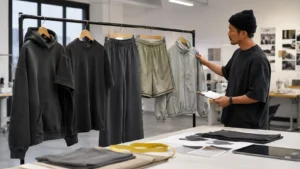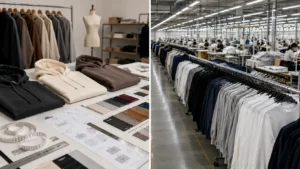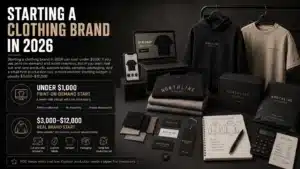
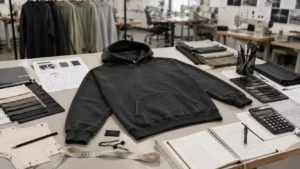
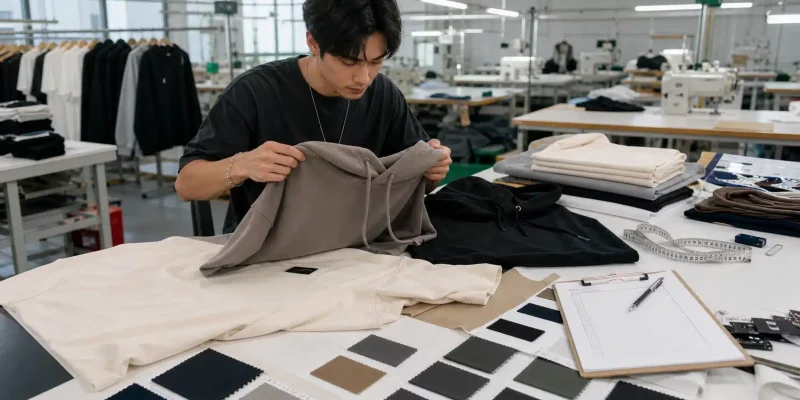
To start a streetwear brand in 2026, you do not need a 20-style catalog or a warehouse full of unsold hoodies. You need a tight first drop, a reliable low MOQ manufacturer, and enough production discipline to test fit, fabric, decoration, and demand before scaling.
The old streetwear launch model pushed founders into high minimums: 300 pieces per style, multiple colorways, and more inventory than a new brand could realistically sell. Low MOQ manufacturing changes the risk. It lets a brand test a hoodie, T-shirt, or matching set with a smaller order before committing to a bigger run.
But low MOQ is not a shortcut around production planning. It only works when the brand makes fewer, sharper decisions.
Start a streetwear brand with one focused product lane
The first production mistake is trying to launch like an established label. A new streetwear brand does not need tees, hoodies, joggers, jackets, caps, bags, and accessories in the first drop.
Start with one product lane:
- Oversized graphic T-shirts
- Heavyweight hoodies
- Hoodie and sweatpants sets
- Acid-washed tees
- Cut-and-sew basics
- One capsule built around a single fabric story
This keeps the MOQ, sample cost, fit approval, packaging, and quality control manageable. If your first drop has one hoodie body in two colors, every review teaches you something. If it has eight unrelated pieces, every issue becomes harder to diagnose.
For most streetwear startups, a strong first lane beats a wide first catalog. The brand looks more intentional, the production team can control the details better, and the founder has less inventory risk.
Know what low MOQ really means
Low MOQ does not mean the factory can make any design, any fabric, any wash, and any print at 10 pieces with bulk-level pricing. It means the manufacturer has a production model that can support smaller test quantities without breaking the process.
On Hezi Apparel’s public site, the stated MOQ starts at 30 pieces for new brands, with low MOQ support positioned for startups, e-commerce brands, KOLs, influencers, and private label programs. That kind of entry point is useful for a first drop, but the exact MOQ still depends on the garment, fabric, decoration, size range, and whether the supplier has suitable materials available.
Use this practical MOQ logic:
| Product Type | Low MOQ Fit | What Usually Raises MOQ |
|---|---|---|
| Graphic T-shirts | Strong fit for startup testing | Custom dye, complex all-over print, special fabric |
| Hoodies | Good fit when fabric is available | Heavy fleece, custom color, multiple decorations |
| Sweatpants / sets | Better after the first product is proven | Size matching, fabric consumption, trim planning |
| Cut-and-sew jackets | Harder for very small runs | Pattern work, lining, zippers, woven fabric sourcing |
| Private label basics | Good if using stable base fabrics | Custom labels, packaging, washing, many SKUs |
The key is to ask what the MOQ is tied to. Sometimes it is fabric dyeing. Sometimes it is printing setup. Sometimes it is cutting efficiency. A useful supplier explains the reason, not just the number.
Build the first drop around samples, not mockups
A mockup can sell the idea internally. A sample tells you whether the product is real.
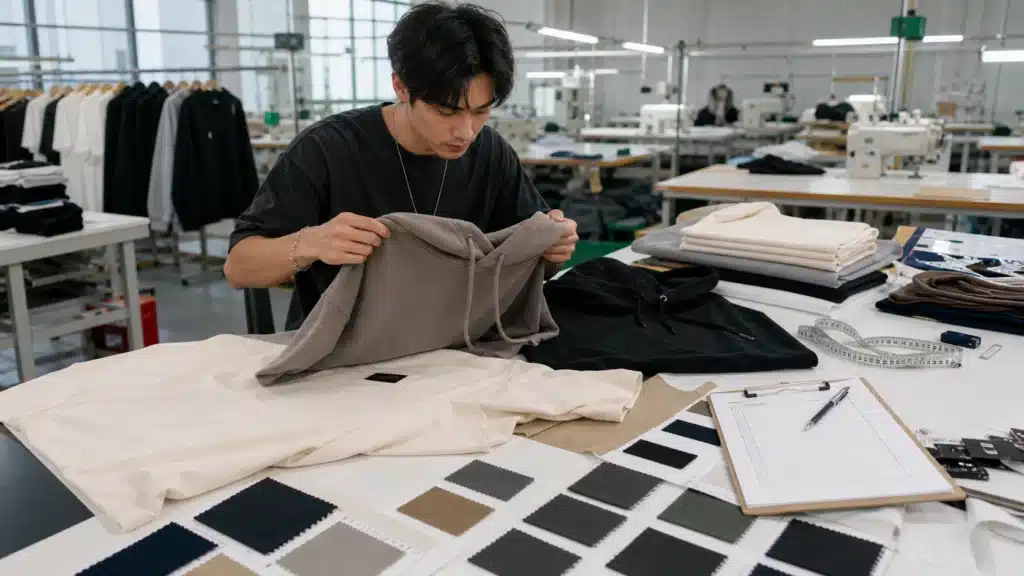
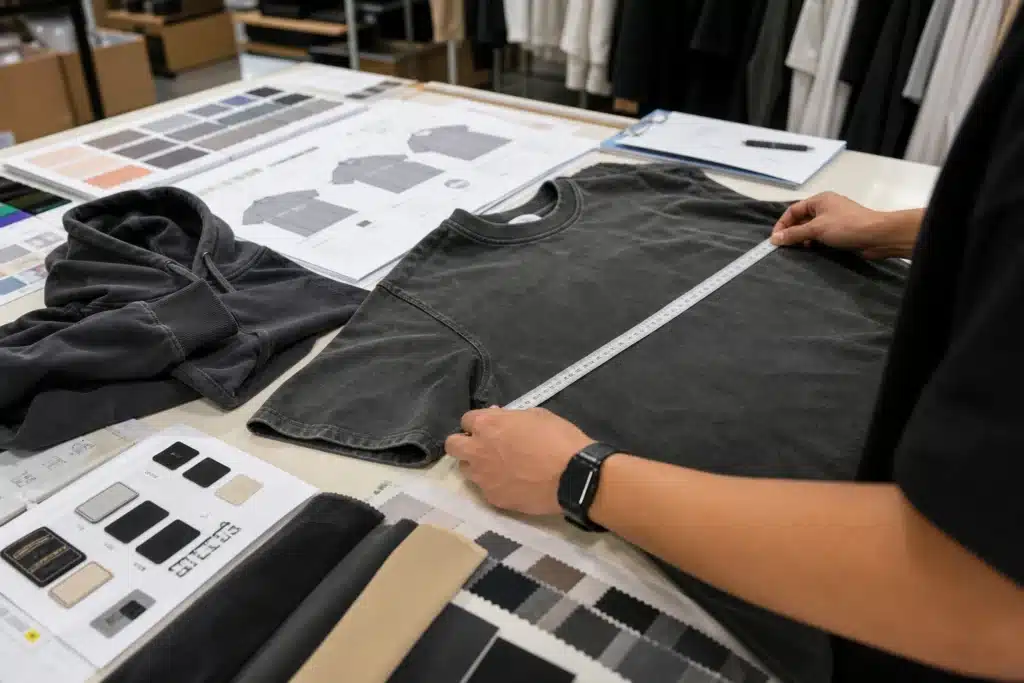
Before bulk production, approve a physical sample for fit, fabric weight, handfeel, decoration, label placement, and wash result. This matters even more with low MOQ manufacturing because small-batch orders leave less room for rework.
For a streetwear hoodie, check:
- GSM and fleece handfeel
- Shoulder drop and sleeve length
- Rib recovery at cuff and hem
- Hood shape and drawcord quality
- Print or embroidery placement
- Shrinkage after washing
- Label, hang tag, and packaging details
For a streetwear T-shirt, check:
- Body length after wash
- Neck rib recovery
- Sleeve opening
- Fabric transparency
- Print handfeel
- Side seam twisting
- Size grading across S-XL or your chosen range
Hezi Apparel states fast sampling support on its site, including references to 7-10 days for custom T-shirts and fast sampling for low MOQ brand programs. Use sampling speed to learn faster, not to skip approval.
Caption: A low MOQ order should still pass the same fit, fabric, wash, and decoration checks as a larger production run.
Choose fabrics that match your brand price
Fabric decides whether a streetwear product feels cheap, premium, or overbuilt. It also changes cost, MOQ, lead time, and defect risk.
A 240 gsm oversized T-shirt can work for a lighter summer drop. A 300 gsm tee feels heavier but may need better pattern control to avoid a boxy fit turning stiff. A hoodie in the 300-500 gsm range can support different brand positions, from everyday fleece to heavyweight statement pieces.
Hezi’s public product copy references 240-500 gsm cotton for acid-washed T-shirts and 300-500 gsm for hoodies and sweatshirts. Those ranges are useful because streetwear buyers often judge garments by weight and structure.
Do not choose fabric by GSM alone. A softer 380 gsm fleece can feel better than a poor 450 gsm fleece if the yarn, brushing, shrinkage control, and rib quality are stronger.
For a first low MOQ drop, choose fabric based on:
- Target retail price
- Climate and season
- Print or embroidery method
- Fit structure
- Wash treatment
- Customer use case
- Whether the fabric is already available
The lowest-risk first drop usually uses a proven base fabric with custom fit, decoration, and branding. Fully custom fabric development can come later, after the brand knows what sells.
Keep decoration simple until the fit is proven
Streetwear founders often overbuild the first sample. They add puff print, embroidery, rhinestones, wash effects, custom labels, custom packaging, and multiple placements before the body fit is even approved.
That is expensive learning.
For a first drop, the best decoration strategy is usually one hero technique:
- Screen print for bold graphics and better bulk consistency
- DTG or digital print for small runs or detailed artwork
- Embroidery for logos and premium brand marks
- Puff print for raised streetwear graphics
- Acid wash or garment wash for texture and vintage attitude
Low MOQ manufacturing gives you room to test, but every added technique creates a new failure point. A hoodie with one clean puff print can teach you more than a hoodie with five competing details.
If your design needs multiple techniques, sample them in stages. Approve the garment base first, then the main decoration, then trims and packaging.
Prepare a useful tech pack before asking for quotes
The fastest way to get vague pricing is to send a vague request.
Do not send only a logo and ask, “How much for 50 hoodies?” A manufacturer has to guess the fabric, GSM, size range, color count, print method, label type, packaging, and shipping expectation. The quote will either be slow, padded, or inaccurate.
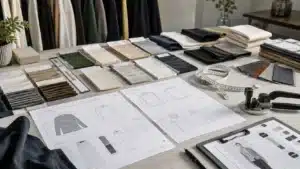
Send a basic tech pack or at least a clear production brief:
- Product type: oversized tee, hoodie, set, jacket
- Quantity: target low MOQ and future reorder expectation
- Fabric: cotton, fleece, GSM, wash, color
- Fit: reference garment or measurement chart
- Artwork: size, placement, colors, print method
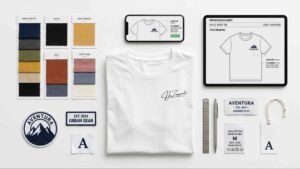
- Branding: neck label, hang tag, packaging
- Size range: S-XL, XS-2XL, or custom
- Deadline: sample date and target launch date
- Market: US, UK, EU, or other shipping region
This does not need to be perfect. It needs to be specific enough for the factory to quote the actual garment, not an imaginary one.
Use low MOQ to test demand, not to avoid planning
Low MOQ manufacturing is strongest when it creates a feedback loop.
A practical first-drop plan looks like this:
- Pick one hero product.
- Approve one fit and one fabric.
- Sample the decoration on the real garment.
- Order a low MOQ batch.
- Launch with limited SKUs.
- Track size sell-through, returns, customer comments, and restock demand.
- Reorder the winners and adjust the next style.
The point is not to stay small forever. The point is to avoid betting the whole brand on untested assumptions.
For example, a brand may discover that customers love the graphic but want a heavier hoodie. Or the fit works, but the neck label scratches. Or the black colorway sells out while the cream color sits. Those are useful lessons because the brand did not commit to a large run too early.
Pick a manufacturer that can grow with the brand
The wrong low MOQ supplier only solves the first order. The right one helps the brand move from testing to repeat production.
When choosing a low MOQ clothing manufacturer, check for:
- Factory-based production rather than only trading
- Clear sampling workflow
- Realistic MOQ explanation
- Fabric and decoration guidance
- Private label support
- Quality control process
- Ability to restock successful products
- Export experience for your market
Hezi Apparel positions itself as a Guangzhou-based streetwear clothing manufacturer with OEM/ODM service, private label support, low MOQ for startups, custom T-shirts, hoodies, sweatshirts, sets, cut-and-sew, labels, tags, and packaging. That combination matters because a startup usually needs more than sewing. It needs help turning a product idea into a repeatable brand item.
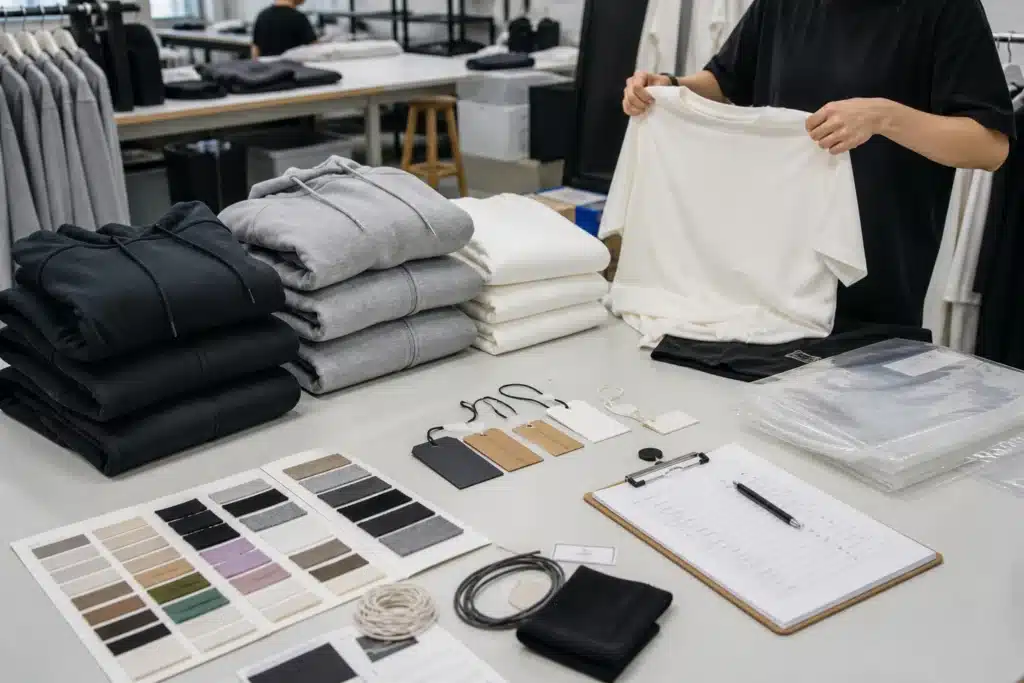
The question is not only, “Can this factory make 30 pieces?” The better question is, “Can this supplier help me make the next 300 pieces better than the first 30?”
FAQ
What is a realistic MOQ to start a streetwear brand?
For simple tees or hoodies, 30-100 pieces can be realistic when the manufacturer supports low MOQ production and the fabric is available. Complex washes, custom colors, jackets, and multi-technique decoration may need higher quantities.
Should I start with T-shirts or hoodies?
Start with T-shirts if your budget is tight and your brand is graphic-driven. Start with hoodies if your positioning depends on premium feel, heavier fabric, or higher retail price. Hoodies cost more to sample and produce, but they can carry stronger brand value.
Do I need a full tech pack before contacting a manufacturer?
A full professional tech pack helps, but a clear production brief is enough for the first conversation. Include product type, quantity, fabric target, fit reference, artwork placement, size range, labels, packaging, and launch timing.
How do I avoid wasting money on samples?
Do not sample too many styles at once. Start with one hero garment, one fabric direction, and one main decoration method. Wash and measure the sample before approving bulk production.
Can low MOQ manufacturing still feel premium?
Yes, if the brand keeps the first drop focused. Premium feel comes from fit, fabric, construction, decoration execution, and packaging discipline. A small order with sharp decisions can look better than a large order with scattered ideas.
The best first drop is narrow, not small
The strongest way to start a streetwear brand with low MOQ manufacturing is to make the first drop narrow on purpose.
One good hoodie or T-shirt can prove your fit, graphic language, supplier communication, packaging, and customer demand. Ten average pieces only create more ways to spend money before the brand has feedback.
Low MOQ is valuable because it lets a founder learn from production without drowning in inventory. A manufacturer like Hezi Apparel can support that learning curve with low MOQ custom streetwear production, fast sampling, OEM/ODM support, and private label details. The smart move is to use that flexibility with discipline: test one product well, sell it clearly, then scale what the market actually wants.
References
Brand / Website Context
- Hezi Apparel home page: https://heziapparel.com/
- Hezi Apparel custom T-shirt manufacturer page: https://heziapparel.com/custom-t-shirt-manufacturer/
- Hezi Apparel FAQ: https://heziapparel.com/faq/
- Hezi Apparel OEM private label clothing manufacturer page: https://heziapparel.com/oem-private-label-clothing-manufacturer/
- Hezi Apparel fabric and printing options: https://heziapparel.com/fabric-printing-options/
- Hezi Apparel custom oversized blank hoodies product page: https://heziapparel.com/product/custom-oversized-blank-hoodies-streetwear/
- Hezi Apparel acid-washed T-shirts product page: https://heziapparel.com/product/custom-acid-washed-t-shirts-streetwear/
Same-Industry / Upstream / Downstream References
- Shopify clothing store startup guide: https://www.shopify.com/retail/how-to-open-a-clothing-store
- Shopify inventory setup guide: https://help.shopify.com/en/manual/products/inventory/setup/initial-inventory-setup
- Techpacker tech pack guide for apparel production: https://techpacker.com/blog/design/what-is-a-techpack/
- Workshelter production spec and tech pack checklist: https://www.workshelter.co/learn/production-lifecycle/writing-a-tech-pack
- Printful T-shirt weight guide: https://www.printful.com/uk/blog/t-shirt-weight-guide
- VistaPrint hoodie fabric and GSM guide: https://www.vistaprint.com/hub/10-types-of-hoodie-fabric
- Sourcify apparel sampling process guide: https://www.sourcify.com/how-apparel-sampling-works/
- Maker’s Row streetwear brand startup guide: https://makersrow.com/blog/how-to-start-a-streetwear-brand/