When clothing entrepreneurs decide to start an online clothing store, the conversation usually begins with Shopify setup, TikTok ads, or Instagram content. Yet from the production floor, the real differentiator is rarely marketing tactics alone. It is the manufacturing model you choose. Different supplier partnerships directly shape your cost structure, product consistency, margin potential, and ultimately your ability to drive profitable traffic and scale.
A heavyweight hoodie in 380–420 GSM feels and performs differently from a 280 GSM version. A 50-piece test run via flexible production carries completely different cash-flow implications than a 300-piece custom OEM order. These decisions affect not only your P&L but also customer reviews, repeat purchase rates, and return on ad spend. Brands that treat manufacturing as a strategic lever instead of a commodity transaction consistently outperform on both margin and marketing efficiency.
Below we break down the seven most relevant manufacturing strategies for brands ready to start an online clothing store in 2026, with real production data on MOQ, unit costs, lead times, and fabric performance.
1. Print-on-Demand (POD) and Dropshipping Models
POD lets you start an online clothing store with virtually zero inventory risk. The supplier (or platform-integrated factory) prints and ships only after a customer orders. Typical methods are DTG or DTF on pre-made blanks.
From the factory perspective, this model minimizes cutting and sewing complexity but limits your control over fabric weight and quality. Most POD hoodies sit in the 280–320 GSM range; true heavyweight 400+ GSM options are rare and carry premium surcharges. Fabric loss is irrelevant because blanks are pre-cut, yet print durability on fleece can vary, sometimes leading to higher return rates on dark or detailed designs.
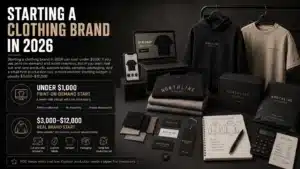
Cost & MOQ reality (2026): No traditional MOQ (1 piece per order). Unit cost for a custom hoodie usually lands between $20–45 depending on print complexity and blank quality. Gross margins often compress to 35–50% after platform fees.
Best for: Validation of designs and audiences with under $3,000 total startup capital. Many brands use POD to test 8–10 SKUs before committing to bulk.
2. Private Label from Supplier Catalogs
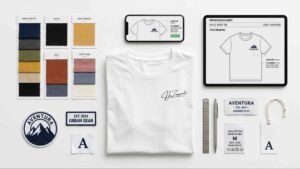
You select existing styles from the factory’s catalog, add your branding (woven labels, hang tags, custom packaging), and order in modest quantities. Production is straightforward because patterns and markers already exist.
Factories love this model for its low development overhead. You still benefit from their optimized marker making, keeping fabric loss rates typically under 8%. However, design differentiation is limited to color, print placement, and trim changes.
Cost & MOQ (2026): MOQ often 50–150 pieces per color/style. Hoodie unit cost $15–30 at 100+ pieces. Lead time from order confirmation: 4–7 weeks including sampling.
Best for: Early-stage brands that want branded product without full tech-pack development costs.
3. Custom OEM with Your Own Designs
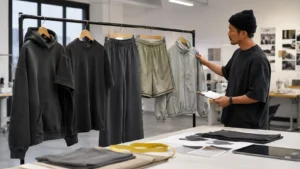
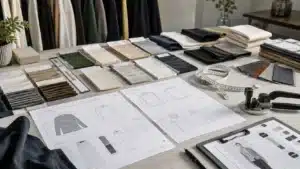
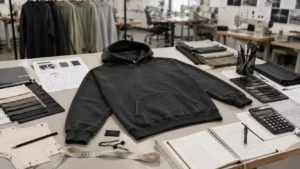
You supply a complete tech pack (measurements, construction details, fabric specifications including exact GSM). The factory sources or develops the fabric, creates or refines patterns, cuts, sews, applies prints or embroidery, and conducts quality control.
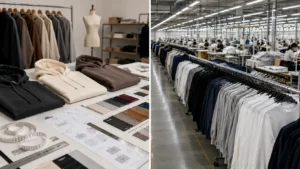
This is where production expertise shines. Skilled factories optimize grading rules (放码) across sizes to maintain consistency and reduce fabric loss to 6–10%. Higher GSM fabrics (350–450) require specific cutting blades and fusing techniques; poor optimization here increases both cost and quality issues. Print method selection becomes critical: screen printing offers superior durability and lower unit cost above 200 pieces, while DTG suits complex, low-volume artwork.
Cost & MOQ (2026): Realistic MOQ 50–300 pieces per style/color (some flexible partners accept 50 with stock fabrics). Heavyweight hoodie unit cost $12–35, dropping significantly above 300 pieces. Sampling: 7–21 days. Bulk production: 4–8 weeks.
Best for: Growth-stage brands ready to own their product identity and build long-term margins.
4. Full ODM (Original Design Manufacturer) Partnerships
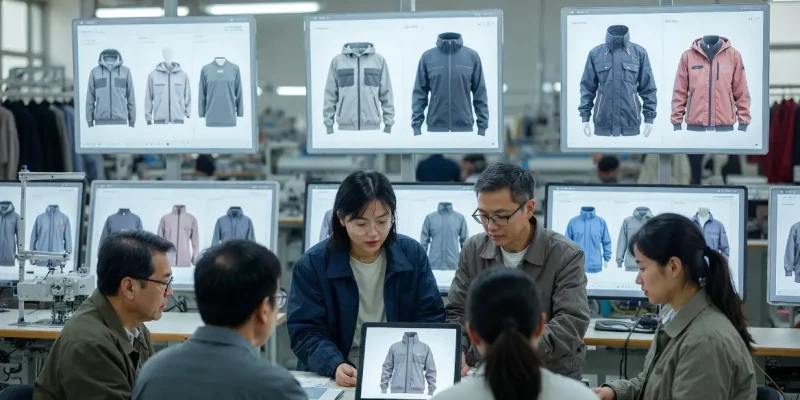
The factory’s design team proposes seasonal collections based on trend research and your brand direction. You approve or refine, then they handle everything from fabric development to production.
ODM reduces your internal design workload and often includes exclusive fabric or trim developments. From the factory side, they control the entire process, allowing tighter control over GSM consistency and wash performance testing. This model shines when you want rapid collection drops without a large in-house product development team.
Cost & MOQ (2026): MOQ typically 100–500 pieces per style. Unit costs can be 10–15% lower than pure custom OEM because of volume efficiencies in fabric booking. Lead time 8–14 weeks for first collection.
Best for: Brands scaling collections or those without strong internal design capability.
5. Flexible Small-Batch / Hybrid Production
Progressive factories now offer “group production” or stock-fabric programs that allow lower MOQs by combining similar orders or using pre-developed fabrics. This bridges the gap between POD testing and full custom runs.
Production teams still apply proper pattern optimization and quality protocols, giving you better consistency than most POD providers while keeping upfront capital manageable.
Cost & MOQ (2026): MOQ as low as 30–100 pieces per style. Unit cost sits between POD and full custom ($18–40 for hoodies). Lead time 4–8 weeks.
Best for: Startups that have validated demand and want to move into branded inventory without massive capital commitment.
6. Sustainable and Certified Manufacturing
GOTS organic cotton, recycled polyester, low-impact dyes, and traceability documentation are now standard requests. Certified factories maintain separate production lines or strict segregation to avoid contamination.
Higher GSM sustainable fleece (380+ GSM organic or recycled) commands premium pricing but also supports stronger storytelling. Customers who pay $90–130 for a hoodie expect and reward transparency; this directly improves conversion rates and organic sharing, helping drive traffic without solely relying on paid ads.
Cost & MOQ (2026): MOQ 100–300 pieces. Unit cost premium of 20–40% over conventional ($25–50+ for heavyweight hoodies). Lead time often 8–14 weeks due to certified material sourcing.
Best for: Growth and mature brands targeting conscious consumers who value authenticity.
Procurement Decision Guide by Brand Stage
Startup phase (first 0–12 months, testing market fit): Begin with POD or flexible small-batch (30–100 pcs). Limit to 2–4 hero styles, ideally including one heavyweight hoodie in 350–400 GSM to establish quality perception. Total first investment can stay under $5,000–8,000. Use sales data to identify winners before scaling.
Growth phase (validated demand, $50k–300k revenue): Transition to custom OEM or hybrid models. Invest in proper tech packs and aim for 150–400 piece runs. Negotiate volume-based pricing and improved payment terms. Focus on fabric consistency (same GSM lot across reorders) to maintain review velocity. This stage is where manufacturing choice most directly impacts your ability to drive traffic profitably—higher margins fund better creative and higher ROAS.
Mature phase (established brand, repeat collections): Move toward long-term ODM partnerships or dedicated production lines. Lock in annual volume commitments for best pricing and priority capacity. Explore exclusive fabric developments (special GSM blends, performance finishes). At this point, your manufacturing partner should function as an extension of your product team, providing trend input and cost-down suggestions every season.
How Manufacturing Quality Directly Influences Traffic and Conversion
High-quality, consistent product reduces returns and generates authentic reviews. A 4.7-star average with comments like “thick premium fabric” or “holds up after 10 washes” improves both organic search visibility and paid ad conversion rates. Unique custom details (custom GSM, special labels, superior construction) give you richer content for Instagram, TikTok, and email — content that drives lower-cost organic traffic. Slim-margin POD models can work for testing, but most successful brands eventually shift to custom OEM to unlock the margins needed for sustained ad spend and brand building.
FAQ: Practical Questions from Clothing Entrepreneurs Starting an Online Clothing Store
Q: Can the minimum order quantity (MOQ) be lower than 100 pieces for custom products?
A: Yes. Many factories now accept 50 pieces per style/color through stock fabric programs or group production. Some flexible partners go as low as 30 pieces for repeat styles. Always ask about consolidated runs or existing fabric inventory.
Q: How much does fabric GSM actually affect customer perception and returns?
A: Significantly. 380–450 GSM heavyweight fleece creates a premium hand-feel and better shape retention after washing. Brands using higher GSM consistently report fewer “thin fabric” complaints and higher repeat purchase rates. From the factory side, proper GSM selection also reduces post-wash shrinkage issues that drive returns.
Q: What is a realistic total timeline from design approval to products live on my store?
A: For custom OEM: 7–21 days sampling + 4–8 weeks bulk production + 2–5 weeks shipping (air or sea). Plan 10–16 weeks for your first custom drop. POD can be live in days but limits your control and margins.
Q: How do I evaluate whether a manufacturer is the right long-term partner?
A: Request recent client references in your niche, review sample accuracy against your tech pack, and assess communication speed during the quoting process. Factories that proactively suggest cost or quality improvements (e.g., alternative GSM options or marker optimizations) usually become true strategic partners.
Q: Can I start an online clothing store profitably with tight margins from POD?
A: Possible for validation, but difficult to scale profitably. Most brands that grow successfully use POD or private label only as a stepping stone, then move to custom OEM to achieve 55–70% gross margins that support meaningful advertising and brand development.
Conclusion: The Strategic Advantage Lies in the Right Manufacturing Partnership
In 2026, the clothing brands that successfully start an online clothing store and scale profitably are those that treat manufacturing not as a transactional cost center but as a core strategic function. The brands winning on margins, review velocity, and marketing efficiency are the ones that align their supplier model with their growth stage and quality positioning from day one.
The key to achieving this long-term success lies in finding a manufacturing partner who not only understands the technology but also the brand value. This is precisely the core value of professional OEM/ODM factories like heziapparel.com – we ensure your brand can successfully launch and grow your online apparel store with lower startup risk, higher profit margins, and faster market response through flexible MOQ options (as low as 30-50 pieces per order), precise GSM specification control and fabric development, optimized pattern grading and low-loss production, and a comprehensive quality and traceability system.
Whether you are validating your first designs or preparing your next collection drop, the right manufacturing partner turns production decisions into competitive advantage. Visit heziapparel.com or contact our team to discuss your specific product requirements and receive a tailored production proposal.