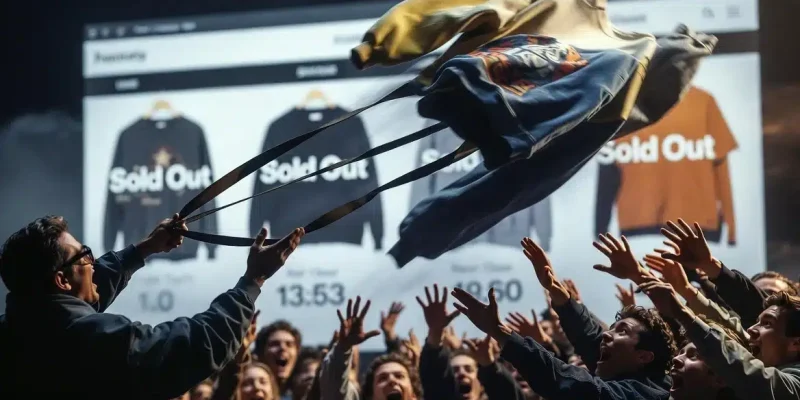
Many clothing brands with existing products still struggle with “launch and silence” — websites go live, inventory arrives, yet sales remain flat. The classic one-time full-inventory drop model is losing effectiveness. It lacks pre-launch momentum, creates high overstock risk, and fails to build lasting brand equity.
Slingshot method clothing offers a proven alternative. Inspired by the physics of a slingshot, it stores energy through controlled limitation (the pull-back) and then releases it explosively for maximum sales velocity. This clothing drop strategy leverages psychological scarcity marketing and loss aversion to create predictable sell-outs instead of slow trickles.
From a factory and supply chain perspective, the real enabler is not just clever marketing copy — it is a manufacturing partner capable of supporting phased, low-risk production.
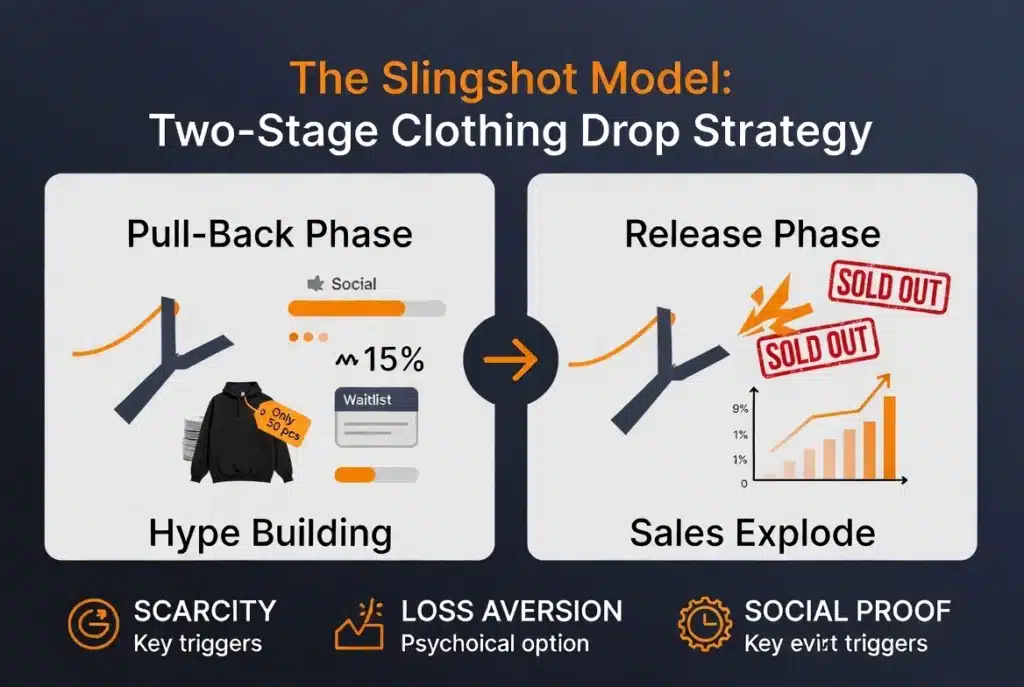
The Core Mechanism of Slingshot Method Clothing: Two-Stage Inventory Release
Slingshot method clothing divides the traditional drop into two tightly connected phases that deliberately build and then release psychological tension.
Phase 1: Pull-Back
Release only 20–30% of planned total inventory. For a 500-piece run of a hero product, launch with just 100–150 units. Key actions include:
- Opening an exclusive waitlist or early-access window
- Clearly stating “Limited to XX pieces — gone when sold out”
- Pairing with premium pricing or bundles
- Running teaser campaigns and countdowns
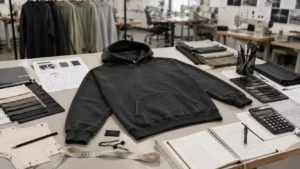
From the production floor, this phase is ideal for low-MOQ + stock fabric execution. A typical 380GSM heavyweight hoodie can start at MOQ 30–50 pieces per color, with FOB unit cost around $18–25 (15–25% higher than bulk). Lead time is usually 35–45 days. The higher per-unit cost is more than offset by near-100% sell-through and the valuable first-party data + UGC collected.
Phase 2: Release
With social proof, email growth, and sold-out validation from Phase 1, launch the larger or complete collection. Factories with reserved capacity can turn around follow-up production in 2–3 weeks. Loss aversion peaks here — customers fear missing the “final chance” before the next controlled drop.
The compound effect is powerful: Phase 1 validates demand and de-risks inventory; Phase 2 converts that momentum into 3–5× sales volume while keeping overall sell-through rates above 85–95%.
The 4 Psychological Triggers That Drive Sell-Outs
- Scarcity — Explicit quantity limits outperform vague “almost gone” messaging. Transparent inventory data from your factory strengthens credibility.
- Loss Aversion — People feel losses roughly twice as strongly as equivalent gains. Countdown timers and “last units” messaging are highly effective.
- Social Proof — Rapid sell-outs from Phase 1 generate authentic UGC and screenshots that become the strongest conversion assets for Phase 2.
- Pavlovian Conditioning— Consistent teaser cadence, notification rituals, and drop rhythm train your audience to respond with excitement and urgency the moment they see a new campaign.
Using “Acquisition Friction” to Increase Perceived Value
Adding deliberate friction to the buying journey actually raises perceived value and commitment. Practical tactics include requiring Instagram follows + shares to join the waitlist, detailed preference forms for early access, or private-community entry only after a previous purchase. These small investments of time and effort make the eventual product feel more earned and desirable — a core principle of psychological scarcity marketing.
Acquiring Precise Traffic and Best Platforms for Streetwear Brands
Slingshot method clothing performance depends heavily on quality traffic rather than broad reach.
- Instagram — Best for visual storytelling, Reels process content, and Stories countdowns.
- TikTok — Ideal for authentic behind-the-scenes videos and FOMO live sessions; micro-influencer collaborations convert efficiently.
- Discord / Private Communities — Perfect for VIP drop notifications and long-term conditioning.
- YouTube — Strong for longer-form brand storytelling and search traffic accumulation.
Layer precise retargeting and lookalike audiences built from Phase 1 buyers to keep customer acquisition costs 30–50% lower than cold traffic.
Supply Chain Perspective: Why Flexible Manufacturing Powers the Slingshot Model
Traditional high-MOQ production forces brands to commit large capital upfront, creating exactly the inventory risk the model is designed to avoid. Successful execution of slingshot method clothing requires a manufacturing partner that offers:
- True low-MOQ capability (30–80 pieces) for Phase 1 testing
- Fast follow-up production with pre-booked capacity
- Stock fabric options to compress sampling and lead times
Quantifiable example (380GSM heavyweight hoodie):
- Phase 1 (50 pcs): ~$22 FOB, 35–45 day lead time, higher per-unit cost but minimal risk
- Phase 2 (300–500 pcs): Unit cost drops meaningfully; overall margin expands due to premium pricing power and zero deadstock
Brands using phased drops consistently achieve 2×+ better inventory turnover and dramatically lower overstock rates compared with traditional full drops.
Comparison Table: Traditional Full Drop vs Slingshot Model
| Dimension | Traditional Full Drop | Slingshot Model | Brand Impact |
|---|---|---|---|
| Initial MOQ | Usually 200+ pcs | 30–80 pcs (flexible) | Significantly lower capital risk |
| Inventory Turnover | 40–60% sell-through | 85–95%+ | Healthier cash flow |
| Psychological Leverage | Weak | Strong (compounded across phases) | Higher conversion & AOV |
| Production Flexibility | Locked upfront | Phased + rapid replenishment | Responsive to real demand |
| Best For | Established large brands | Cold-start to growth-stage brands | Reduces launch failure rate |
Procurement Decision Guide by Brand Stage
- Cold-start / Early-stage brands: Choose factories that support true low MOQ. Focus on one hero product and run the full Slingshot Model to validate demand with minimal exposure.
- Growth-stage brands: Apply the model to new collections or seasonal limited drops to sustain momentum and efficient traffic.
- Mature brands: Use controlled Slingshot drops for testing new categories or collaborations while protecting existing inventory health.
FAQ
Q: What is Pavlovian marketing and how does it apply to clothing drops?
A: Pavlovian (or conditioned-response) marketing uses repeated stimuli to train automatic reactions. In drops, consistent teaser → countdown → notification rhythms condition your audience to feel excitement and urgency the moment they see a new campaign.
Q: How can “acquisition friction” increase perceived product value?
A: Requiring small efforts (following, sharing, or filling forms) to gain access makes the product feel more exclusive and earned, strengthening desire and loyalty — a key tactic within psychological scarcity marketing.
Q: How does the slingshot method clothing help brands acquire precise traffic?
A: Phase 1 sell-outs create authentic social proof that lowers CAC in Phase 2. Combined with retargeting and community building, it attracts high-intent buyers instead of broad, low-quality traffic.
Q: Which social platforms best suit streetwear brand tone?
A: Instagram (visuals & Reels), TikTok (process content & FOMO), and Discord (VIP community & notifications) align most naturally. YouTube works well for deeper storytelling.
Q: Can MOQ support a true two-phase Slingshot strategy?
A: Yes. Partner with flexible manufacturers who accept low initial MOQ for testing and offer fast replenishment. Many can start with stock fabrics at 20–50 pieces, then scale quickly once demand is proven.
Conclusion: A Production-Line Perspective on 2026 Drop Strategy
In today’s market, simply making good product and hoping for sales is no longer viable. Brands that continue releasing full inventory in a single drop will keep facing cold starts and deadstock. Those who adopt the Slingshot Model — deliberately orchestrating inventory release and psychological triggers — achieve more reliable explosive growth and stronger brand equity.
The decisive factor is finding a manufacturing partner that understands both technical flexibility (low-MOQ phased production, rapid response) and brand psychology. This is exactly the core value of heziapparel.com. We enable brands to execute high-upside drop strategies safely through true phased production support, low initial MOQ testing, and supply-chain intelligence tailored to streetwear and contemporary clothing brands.
Ready to design your next sold-out drop with the Slingshot Model? Visit heziapparel.com to speak with our team about customized production planning and flexible MOQ solutions.